


For years, Elvin Karana, Professor of Materials Innovation and Design at TU Delft, has explored how biotechnology and design can come together to create materials for everyday life, while remaining aligned with ecological cycles and temporalities.
Text by Sifra Hordijk (Vesper Concept)
When Karana presented a lightweight foam grown from bacteria to investor Jeroen van Rotterdam, he immediately recognized its potential as an alternative to conventional synthetic foams such as Styrofoam. “This is remarkable,” he said. “Styrofoam is one of the most problematic materials we have. It is toxic to produce, and even now, essentially impossible to recycle. I'd like to invest in this.”

That conversation marked the beginning of Foamlab, a TU Delft spin-off founded by Karana and Van Rotterdam. Unlike conventional foams, which rely on fossil resources, Foamlab's material is grown through fermentation. Bacterial cellulose is cultivated in liquid cultures by bacteria that consume sugars as food and secrete cellulose outside their cells. The result is an extremely fine and dense network of fibers that forms naturally, without the need for chemical treatments. It is dried using a proprietary process developed by the team resulting in strong and ultra-lightweight foam with excellent thermal insulation properties.
“The possibilities are immense,” says Karana. Cellulose is a widely used building block for biomaterials. But bacterial cellulose is the purest form of cellulose which opens doors to many high-performance applications. The material has the potential to be used in construction, textiles, specialised packaging and even cosmetics.
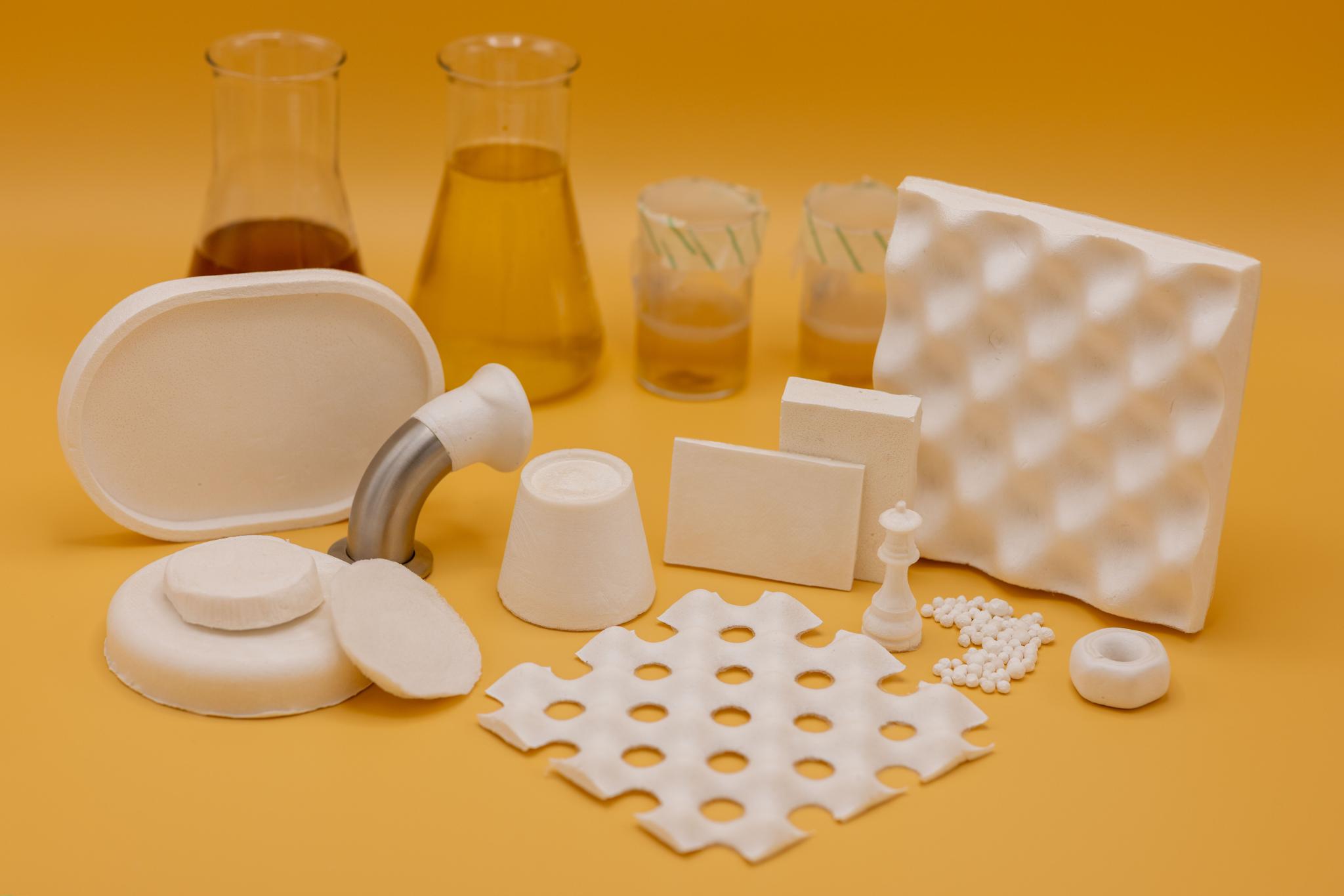
Just a few years after its founding, Foamlab has secured enough venture capital to build a pilot facility to scale up production. This presents new challenges: “Living organisms require carefully controlled environments which is more easily achieved in Lab conditions,” Karana says. “Besides, production must remain resource and energy efficient as volumes increase.” For Karana, the larger ambition is to show that this shift — from extracting materials to growing them — can work at large scale without losing the regenerative ambition of the project.
Our foam fully decomposes in a matter of weeks in soil.”
More than replacing petroleum-derived materials by a bio-based alternatives, Karana’s ambition is to design materials that participate in living systems throughout their lives. The challenge is then not only to rethink what the materials are made from, but also how they are produced and what happens to them during use and end-of-life. “We’re exploring local waste streams as our sugar source, and we ferment using some of the oldest techniques there are — nothing energy-intensive, no heavy machinery,” says Karana. “There are no toxic chemicals anywhere in the process, and because our drying process allows for a porous structure, our foam fully decomposes in a matter of weeks in soil.”
The team is now conducting tests to assess the regenerative potential of the foam. “To put real numbers on the full picture, we are assessing the foam from production through to end-of-life,” Karana explains. They are also exploring applications that could directly benefit the environment, for example by creating temporary habitats for other species or providing a food source, potentially moving the material beyond carbon neutrality towards a positive contribution to ecosystems.